
Moskowitz Bayse is pleased to present new works by New York-based artist Julia Weist (b. 1984) in the Positions sector of Art Basel Miami Beach 2026. This solo presentation traces an extraordinary sequence of events, prompted by a New York State investigation into the legitimacy of Weist’s use of her private investigator’s license as a tool with which to make art. The bodies of work included examine how knowledge is acquired, expertise is recognized, and institutional authority is exercised.
Weist's practice has long explored the circulation and restriction of knowledge, often taking libraries, archives, and public records as both subject and material. Following a residency at the New York City Department of Records & Information Services from 2019-2020, she was inspired to apply for a private investigator’s license in service of her practice, in an effort to gain and explore the afforded access to information legally inaccessible to ordinary citizens. New York State requires applicants for such credentials to demonstrate 6,240 hours of qualifying professional experience; Weist argued that her research-based artistic commissions and projects fulfilled this requirement, passed the necessary examinations, and was awarded her license.
For the next two years, Weist used these credentials to mine sensitive personal information and surveillance databases, and transformed found content into artworks that exposed the vulnerabilities of individual privacy, the pervasive reach of contemporary surveillance, and the regulatory loopholes that enable it. Following the exhibition of this work at Moskowitz Bayse in September 2024, she published an opinion piece in the Albany Times Union describing the privacy vulnerabilities she had encountered. Shortly thereafter, the New York Department of State initiated an inquiry into her qualifications, questioning whether artistic research constituted professional investigative experience.
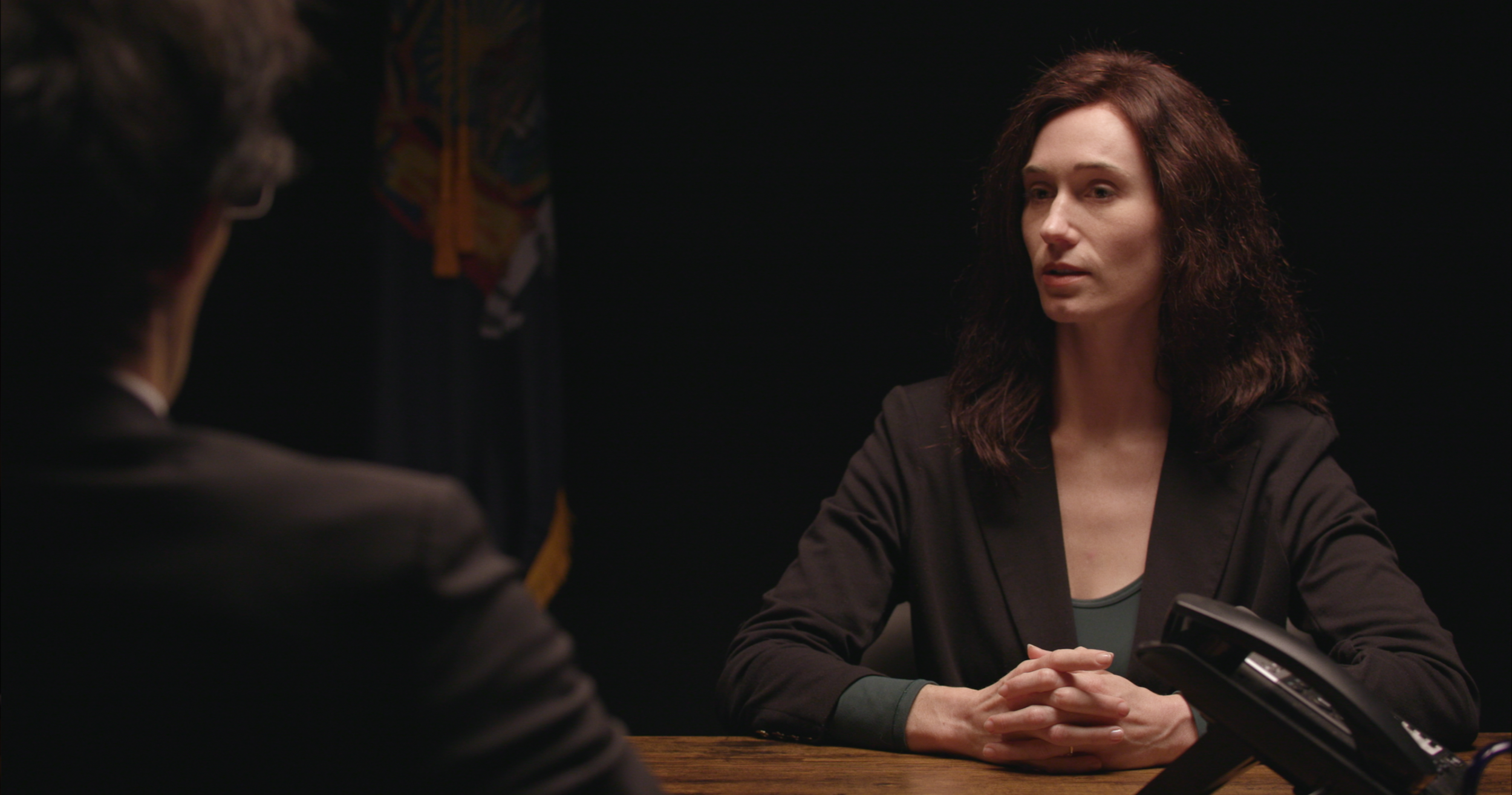
Summoned to a government office in Albany, Weist was interrogated by state investigators and legal counsel about the nature of her work, the distinction between artistic and professional investigation, and the basis upon which artists are compensated. The inquiry exposed a fundamental difficulty in separating the methods of an artist from those of an investigator: both gather information, examine material evidence, and construct findings for an audience. After approximately eight months, the state closed its investigation without revoking Weist's license, tacitly affirming that her artistic experience satisfied its requirements.
Following the investigation, Weist obtained her case file through a Freedom of Information Law request, only to discover that the state's video recording of the interrogation was missing. Despite repeated appeals, the Department of State maintained that the footage could not be located. Weist, however, had independently recorded the conversation on her phone. The interrogation became the basis for Questioning (2026), Weist’s video artwork and first theatrical production of the same name, which premiered at New Theater Hollywood in July 2026 to seven sold-out performances. Using her recorded audio, she reconstructed the encounter with actors who lip-synced to the original exchange, reproducing its hesitations, interruptions, and unexpectedly philosophical turns. Simultaneously documentary and reenactment, Questioning transforms an administrative proceeding into a public encounter, using artistic production to make visible an exchange that had otherwise been withheld.
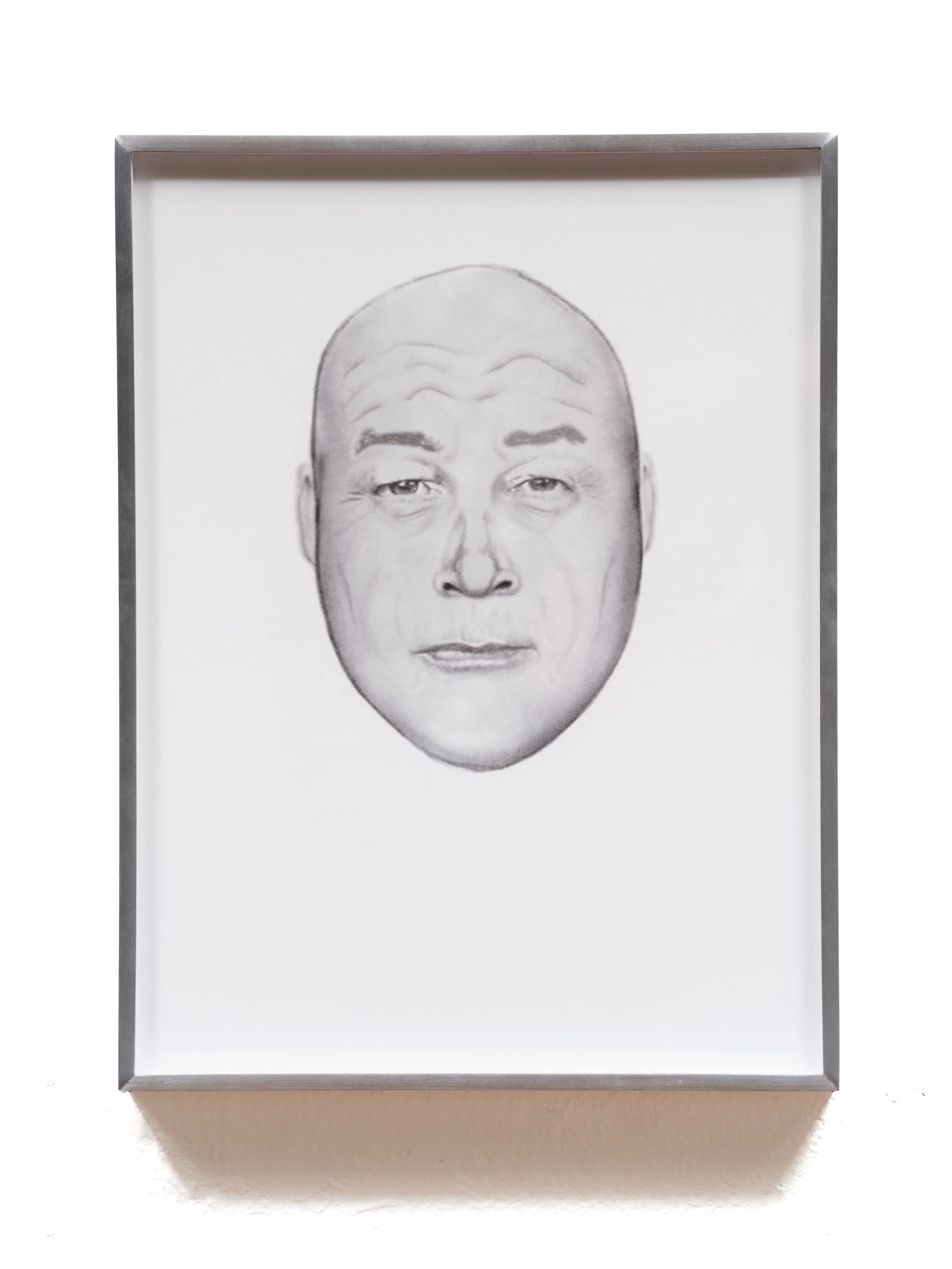
The accompanying series Casting Call (2025-26) comprises three works documenting the unusual process of casting the production. Unable to access the state's video recording, Weist used a forensic sketch application called SketchCop® to reconstruct the appearances of two investigators from memory. The resulting forensic portraits, Casting Call: Senior Investigator Berent and Casting Call: Deputy Chief Investigator Goldman, employ the conventions of criminal identification to facilitate the casting of actors who would portray the officials responsible for investigating her. The third work, Casting Call: Portrait of the Artist as an Actress, is a professional headshot Weist commissioned of herself, acknowledging the equally peculiar necessity of casting an actress to play Julia Weist. Together, the works complicate the relationship between witness, subject, and performer, revealing how the reconstruction of an event necessarily involves acts of interpretation and representation.
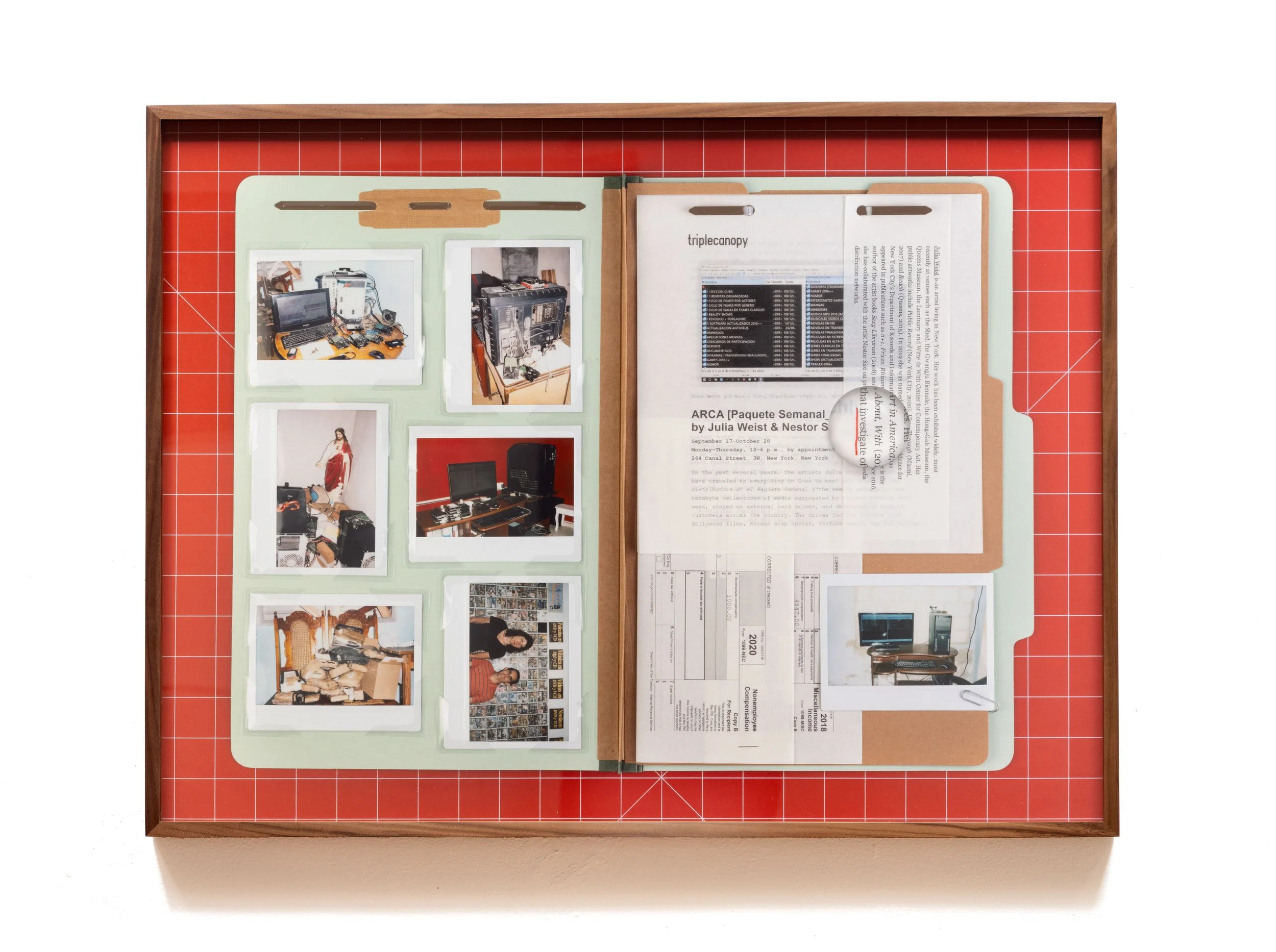
In Curators Agree (2025), Weist addresses the evidentiary logic of the state's investigation from another direction. Seeking to establish that her artistic activities constituted professional investigative work, she assembled documentation of the language used by curators and cultural institutions to describe her practice, particularly instances in which her work was characterized as an investigation. Works including Curators Agree (Triple Canopy) and Curators Agree (Queens Museum) organize these materials and related financial documentation into compositions resembling research files or evidentiary displays. Statements originally intended to contextualize artworks are recast as professional testimony, exposing the contingent nature of expertise and the institutional frameworks through which it is recognized. A related 2026 photograph, "Is the word investigations...is the 'I' word...will we find it anywhere?", makes the state's search for a particular vocabulary of professional legitimacy itself the subject of the artwork.
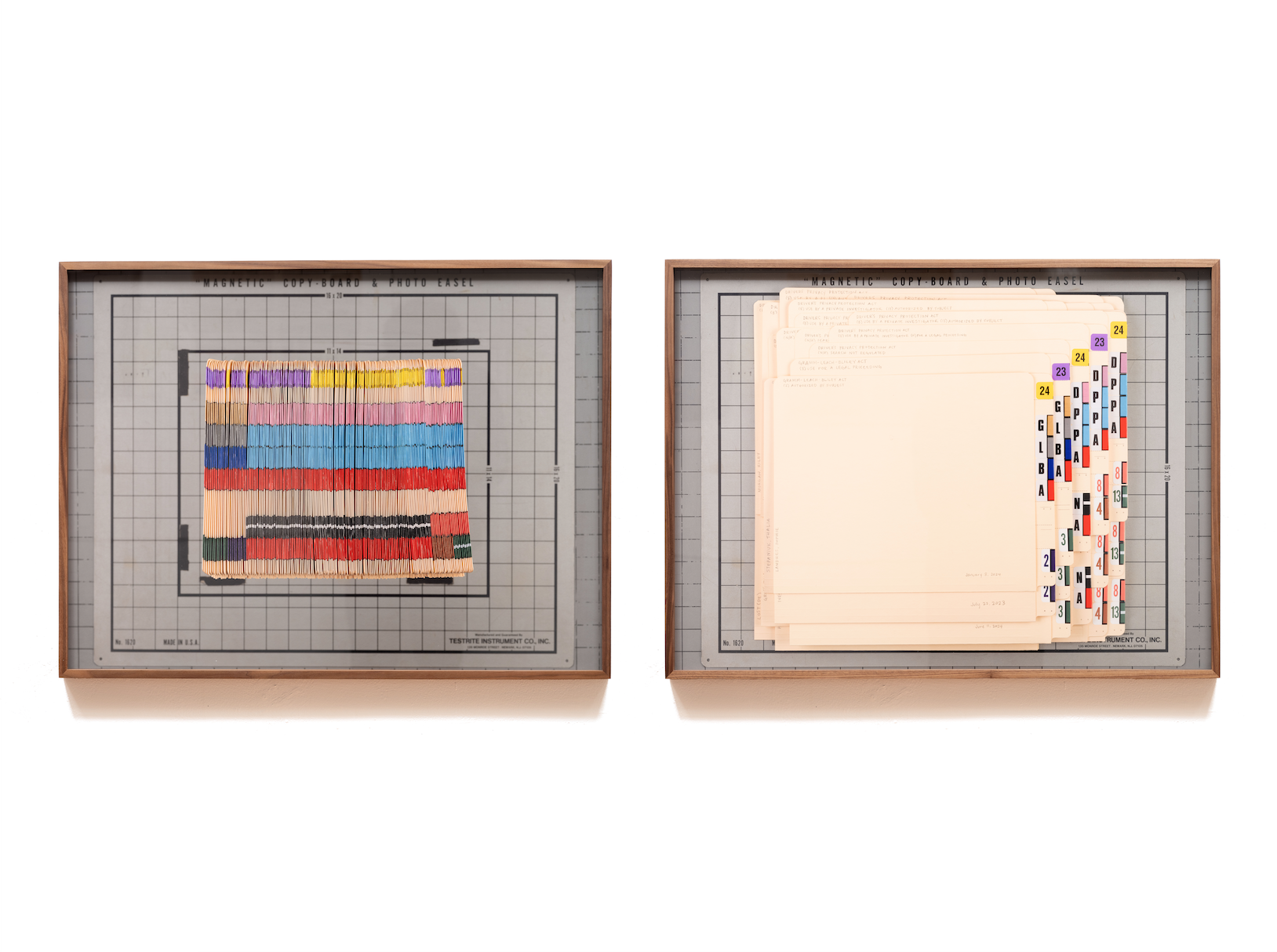
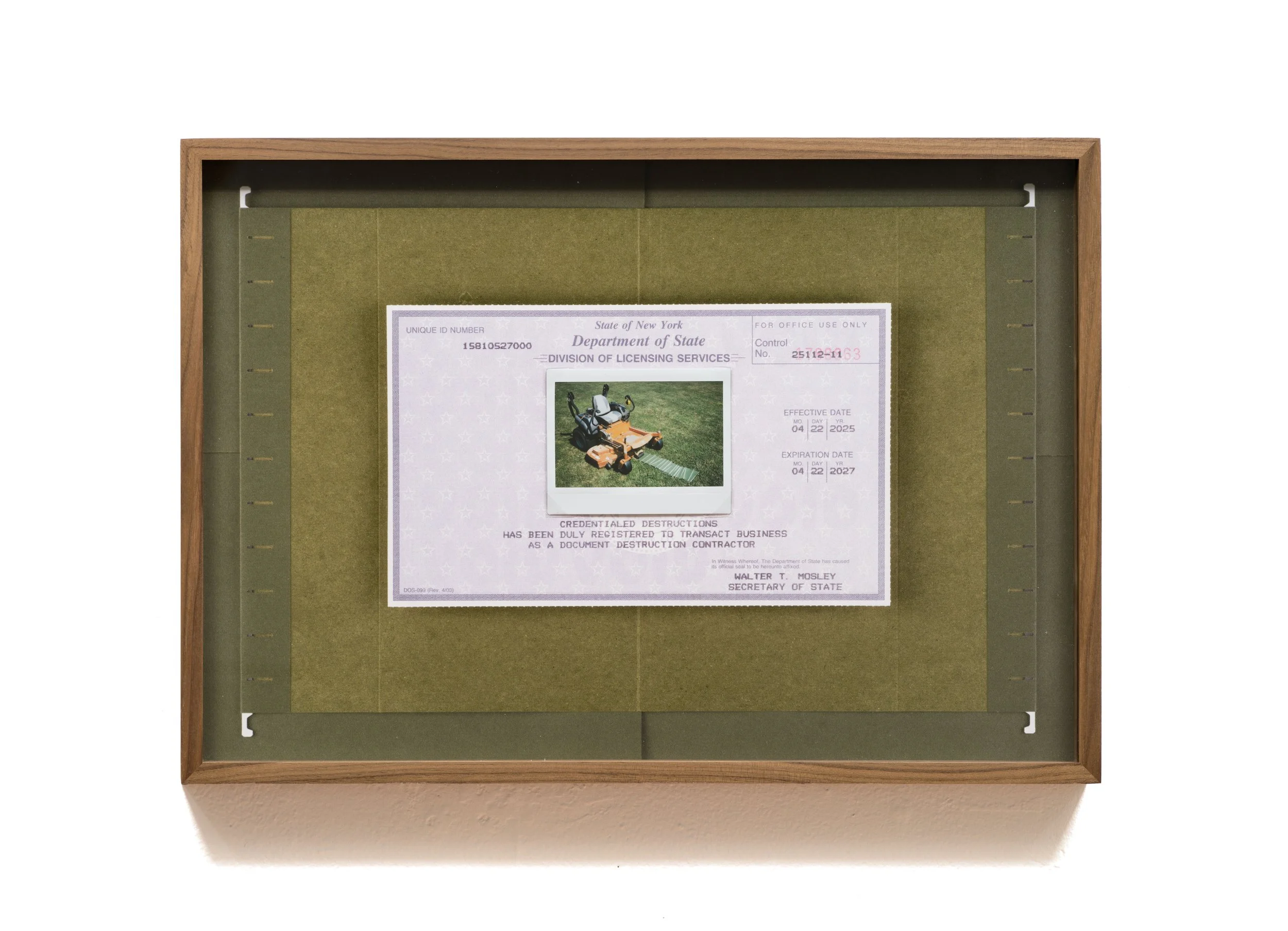
In Credentialed Destructions (2025–26), Weist extends this inquiry into another area of state-regulated activity. Following the conclusion of her investigation, she obtained a New York State license as a Destruction Contractor, granting her authority to destroy records containing sensitive personal information. Unlike the stringent requirements governing private investigators, regulations surrounding document destruction allow considerable latitude in how the task is performed, requiring only that personally identifying information be rendered irrecoverable.
Weist approaches this ambiguity as an invitation to experiment, documenting unconventional methods of destroying records through processes ranging from the industrial to the organic and absurd. In Ledger/Train Tracks (2025-26), Bankers Box/Mushroom Spores (2025-26), Briefcase/Pigeons (2025-26), and Hanging Files/Lawnmower (2025-26), familiar objects of administrative storage encounter destructive forces far removed from the office shredder. The resulting compositions occupy an ambiguous space between procedural documentation, photographic still life, and conceptual instruction. An accompanying advertisement placed in the Albany Times Union offers Weist's unconventional destruction services to the public, returning the project to the newspaper whose readership includes the officials responsible for regulating her professional activities.
Across the presentation, Weist treats bureaucracy not simply as an object of critique but as a productive artistic medium. Licenses, case files, professional testimony, forensic composites, and destroyed documents become instruments through which institutional authority can be examined and redirected. Rather than opposing artistic freedom to regulatory constraint, Weist locates creative possibility within the very structures that appear to delimit it, turning the state's mechanisms of classification, authorization, and documentation into tools for questioning their underlying assumptions.
Julia Weist (b. 1984, New York) is the only licensed private investigator in America whose work is in the permanent collections of the Museum of Modern Art, Whitney Museum of American Art, Guggenheim Museum, Brooklyn Museum, Art Institute of Chicago, and Los Angeles County Museum of Art, among many others. Her work has been exhibited extensively and she is the recipient of numerous awards and fellowships from MacDowell, Yaddo, Millay, the Shed, the Jerome and Camargo Foundations and the Foundation for Contemporary Art. She has been selected for a public art commission by the City of New York and her latest public artwork was presented in Times Square.
The boundary-blurring nature of Weist’s practice has produced coverage in an incredibly wide range of publications such as the New Yorker, New York Times, NPR, Paris Review, Frieze, Art in America and Artforum, but also WIRED, Vice, AdWeek and Popular Mechanics. Weist is based in upstate New York where she has been an Artist in Residence at Bard College since 2023.